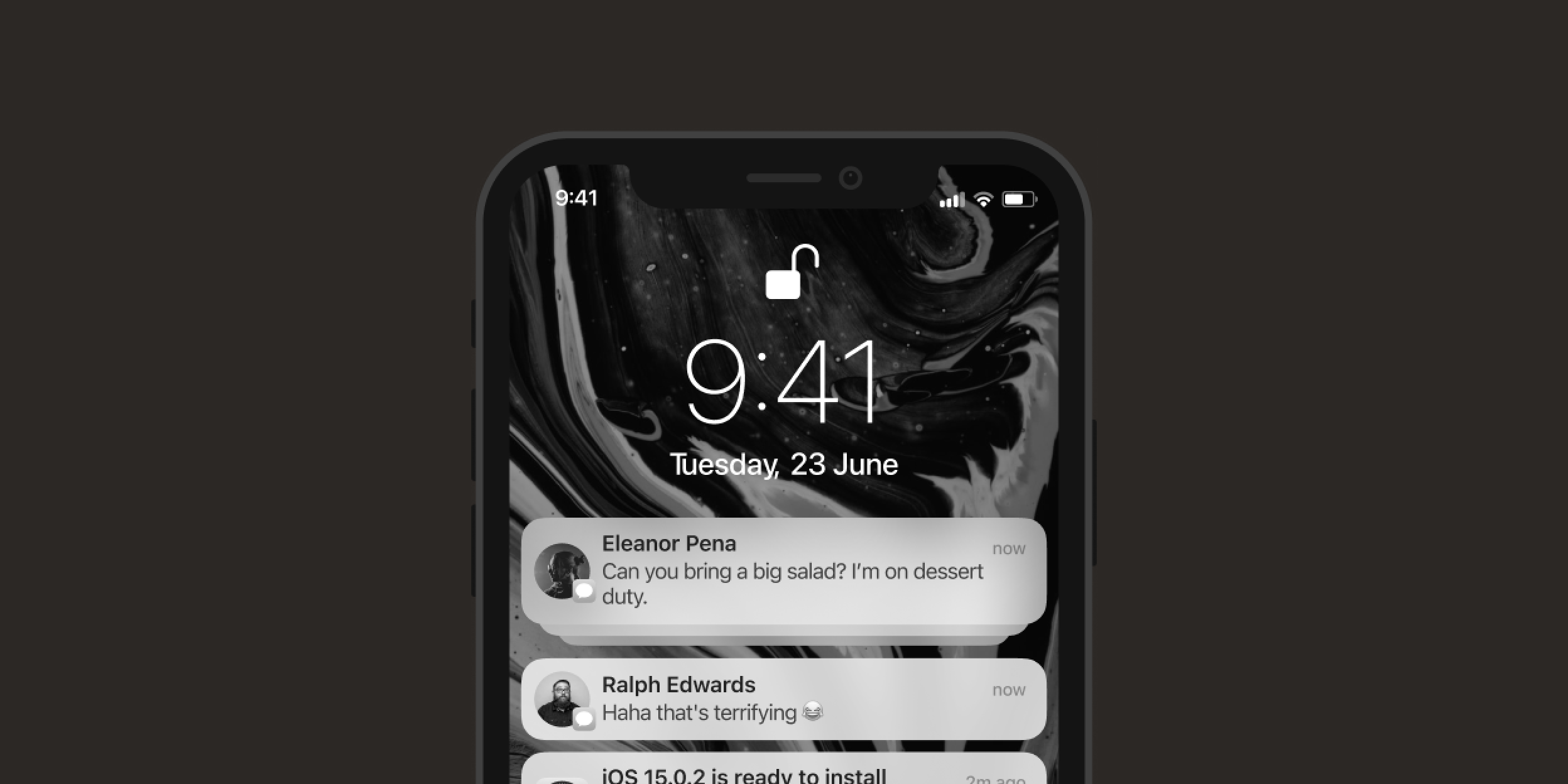
Most reminder systems do not fail dramatically. They fail in a very ordinary way.
The notification appears. The timing is technically right. The device buzzes. The banner shows up. And still, the thing does not get done.
Not because the person does not care.
Because the reminder arrived through the same worn-out channel as everything else.
That is the real weakness of modern notifications. They are cheap to send, and just as cheap to ignore.
The quiet collapse of the notification contract
Push notifications used to feel urgent. Now they feel ambient.
They are no longer reserved for what matters. They carry everything: breaking news, marketing nudges, shipping updates, calendar alerts, password codes, group chats, abandoned cart prompts, political chaos, weather changes, and reminders that were supposed to help you stay on top of your life.
Once every app learns how to interrupt you, interruption stops meaning much.
That is why the broader notification story matters so much for reminder products. If the channel has been worn down, your reminder inherits the damage.
On June 20, 2025, ITV News reported on a Reuters Institute study showing that almost 80% of respondents did not receive news alerts in a typical week, and that 43% of people who did not receive them had actively disabled them. CNN’s coverage of the same study reported the same pattern. These were news alerts, not reminder apps, but the signal is hard to miss: people are increasingly treating notifications as noise to manage, not guidance to trust.
That changes the ground underneath every app that relies on a standard push.
Ignoring reminders is not a character flaw
Productivity culture tends to moralize this too quickly.
If you miss a reminder, the implication is that you are disorganized. If you swipe it away, maybe you are undisciplined. If you keep forgetting, perhaps the solution is a better system, tighter routines, a more aesthetic app, or more self-control.
Usually it is less dramatic than that.
You are in a meeting. You are carrying groceries. Your kid is talking to you. You are trying to leave the house. You are already late. You see the reminder. You know it matters. You also know you cannot act on it in that exact second.
So you defer it.
And that tiny act of deferral is where many reminders disappear.
The problem is not always memory. Often it is the weakness of the interruption.
Importance and urgency keep getting flattened
The modern notification tray is a bad place to express hierarchy.
Everything shows up with roughly the same visual grammar. A message from a friend, a flash sale, a calendar alert, and the reminder to leave for a doctor appointment all compete in the same small strip of attention.
This is a design problem masquerading as a discipline problem.
Most apps do not give important reminders a meaningfully different delivery method. They just send another notification and hope that context, timing, and sheer good luck will do the rest.
Sometimes that works. Often it does not.
Stronger reminders do change behavior
The case for better interruption is not just intuitive. There is real evidence that reminder design affects action.
A randomized trial published in 2018 found that two automated reminders were more effective than one at reducing missed appointments, without lowering visit satisfaction. Another study found that reminder calls and follow-up calls could improve show rates when appointments were scheduled in a timely window. A systematic review in orthodontic care found that reminders reduced missed appointments and improved adherence.
None of this means every task deserves escalation.
It does mean that the delivery channel matters. Reminders are not neutral containers. Some forms are easier to ignore than others.
That should not be a controversial idea. It should be table stakes.
A better reminder system is not necessarily a bigger one
Most people do not need more features around reminders.
They do not need six different calendar views, more color labels, or another layer of productivity theatre. They need a reminder system that recognizes a simple truth:
Some commitments need more weight than a dismissible banner.
That could mean multiple reminders. It could mean a different cadence. It could mean a better relationship between planning tools and action tools. And in some cases, it means a stronger channel entirely.
One useful way to think about it is by consequence.
- If the task is low stakes, a quiet notification is often fine.
- If the task is easy to postpone, multiple reminders may be better than one.
- If missing the moment carries real cost, the interruption may need more weight than a standard push can provide.
That is where Jules becomes relevant, but it should not need to dominate the argument. The important point is broader than any one product: the channel matters. A phone call does not blend into the notification tray the way a push alert does. You do not have to believe phone calls are the answer to everything to recognize the design logic.
That is the part a lot of reminder software still skips.
It helps you remember in theory. It does not help enough in the moment that actually counts.
The better question
The question is not, “How do we send more reminders?”
The better question is, “What kind of interruption does this moment deserve?”
For low-stakes tasks, a quiet notification is probably enough.
For the things that carry actual consequence, it often is not.
And until more products are willing to admit that, people will keep doing what they are already doing: seeing the reminder, postponing it for a moment, and then watching it disappear into the rest of the day.
If that pattern feels familiar, it is also the problem Jules is built around. Not more reminders for the sake of it, but a stronger reminder channel for the moments that should not be lost in the same stream as everything else.